
"RECOGNISE, RESPOND, SUPPORT: Practical workplace responses to stalking" is a free, practical resource for employers and workplaces supporting staff who are experiencing stalking.
Your response as an employer matters
Stalking may happen inside and outside work and it can quickly become a workplace safety issue. The way an employer recognises warning signs, responds to disclosures, manages safety risks and supports affected staff can help reduce harm.
For an employee experiencing stalking, work can be a place of safety, support and connection. But without the right response, it can also become another place where harm reaches them.
A person using stalking behaviours may contact an employee at work, follow them to or from work, appear at the workplace, contact colleagues or managers, or try to disrupt their employment and professional reputation.
Some workplaces may be more exposed to stalking-related risks, especially those involving frequent contact with a wide range of people, public visibility, a duty of care to clients, or customer-facing and hands-on roles.
Download and read "RECOGNISE, RESPOND, SUPPORT: Practical workplace responses to stalking" to prepare early to respond with confidence. Start a workplace conversation about stalking. Share the guide in your workplace and with your networks. Create a safe environment where staff feel supported.
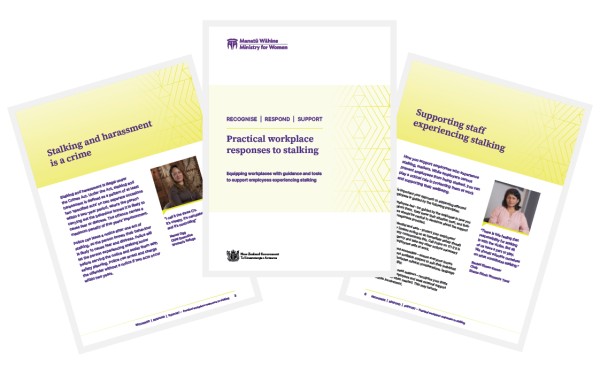
How this guide can help your workplace recognise, respond and support
- Understand stalking and how it can affect employees and workplaces.
- Recognise when stalking may be creating risks at work.
- Respond safely and supportively when an employee discloses stalking.
- Use practical tools, including conversation prompts and safety and wellbeing planning.
- Prepare your workplace before an issue arises – reduce risks and create safer workplace systems.
- Share legal options and specialist support services with employees.
- Respond with confidence when staff need support.
- Create an environment where employees experiencing stalking feel listened to, supported and kept safe.
The guide has been developed with family violence specialist organisation Shine in collaboration with Human Resources New Zealand.
How stalking impacts workplaces and employees
- Women's Refuge research shows stalking frequently extends into workplaces. Victim-survivors report behaviours such as stalkers contacting employers or colleagues, appearing at workplaces and disrupting employment and professional reputations. Research by TK Logan and Katie Showalter in 2022 shows stalking can substantially affect victim-survivors’ employment, particularly through on-the-job harassment, work disruption and job performance problems.
- A Women’s Refuge study of victim-survivors stalked by former partners shows:
- More than 70% of victim-survivors report the perpetrator sat outside their home, school or workplace.
- One in four victim-survivors surveyed report the perpetrator repeatedly phoned their employer. The study indicates this tactic may be used to sabotage victims’ employment and damage their reputation with managers or colleagues.
- Research from the USA Bureau of Justice Statistics in 2022 found that 17% of stalking victim-survivors described losing a job or job opportunities. 2009 data from the National Crime Victimisation Survey in the USA shows that 1 in 8 employed stalking victims lost time from work and more than 50% of those victim-survivors lost five days of work or more.